Research project
Safe Learning for Legged Robots
Walking policies must handle changing contacts, terrain, and disturbances. We combine structured control and reduced-order models with learning, then evaluate the resulting behavior in simulation and robot experiments.
- Structure policies with walking models
- Learn control behavior in simulation
- Evaluate performance and safety conditions
The problem
Learning a locomotion policy must address changing contact dynamics, disturbances, and the gap between training and robot experiments. Safety properties also depend on the model and conditions under which they are derived.
Our approach
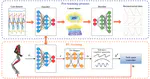
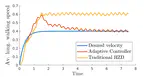
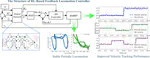
We combine structured control policies and reduced-order walking models with reinforcement learning. Work includes cascade motion policies, compact terrain representations, and model-informed step-to-step prediction for safe learning.
Results and experimental setting
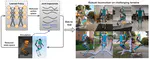
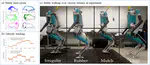
- Learned walking on hardware: The cascade-policy work includes Digit walking experiments, with a linked lab demonstration.
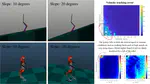
- Terrain-aware representations: The TCST 2026 journal paper evaluates locomotion in high-fidelity simulation and reports preliminary hardware sensor comparisons.
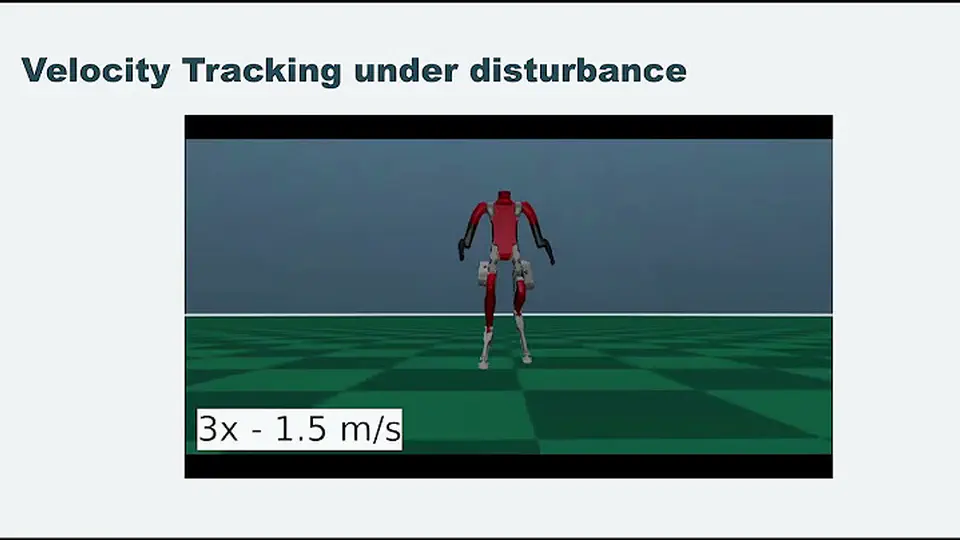
- Model-informed safe learning: The 2026 study evaluates full-order Digit in MuJoCo, using step-to-step predictions to inform policy learning and runtime foot-placement filtering.
Safety conditions: The safe-learning certificate applies to the reduced-order model under the paper’s assumptions. Each study identifies its own training, simulation, and hardware evaluation conditions.
Papers and demonstrations
- Cascade motion policy design (IEEE Access, 2022)
- Terrain-aware locomotion representations (TCST 2026)
- Model-informed safe reinforcement learning (2026)
Watch model-informed safe learning and the earlier learned Digit walking experiments.
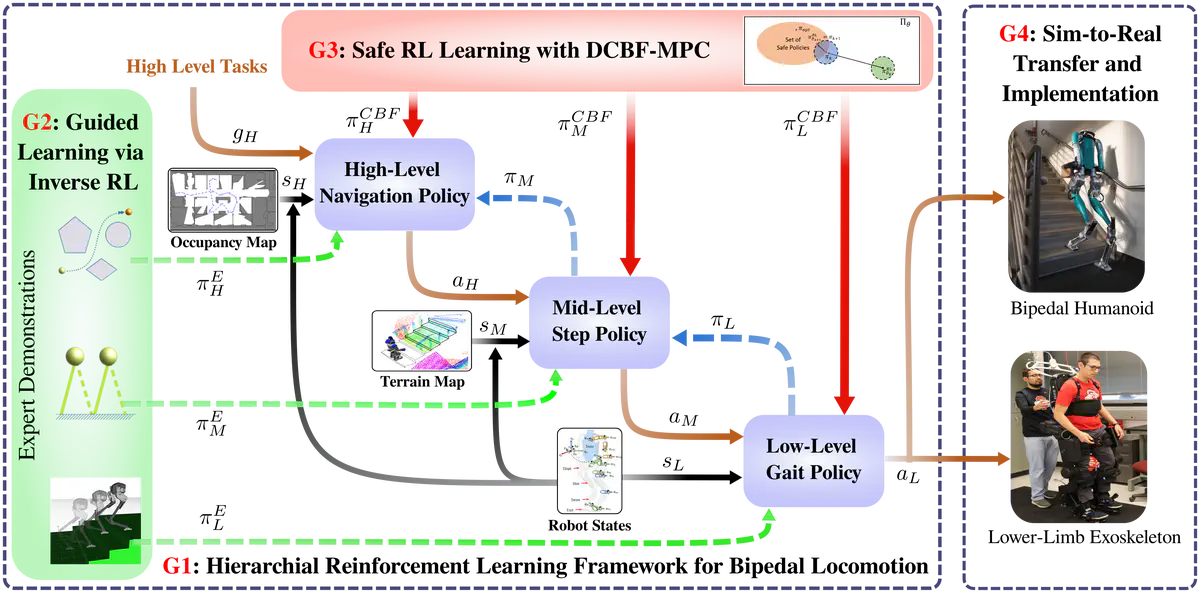
Explore the original project-goals diagram