Research project
Whole-Body Control
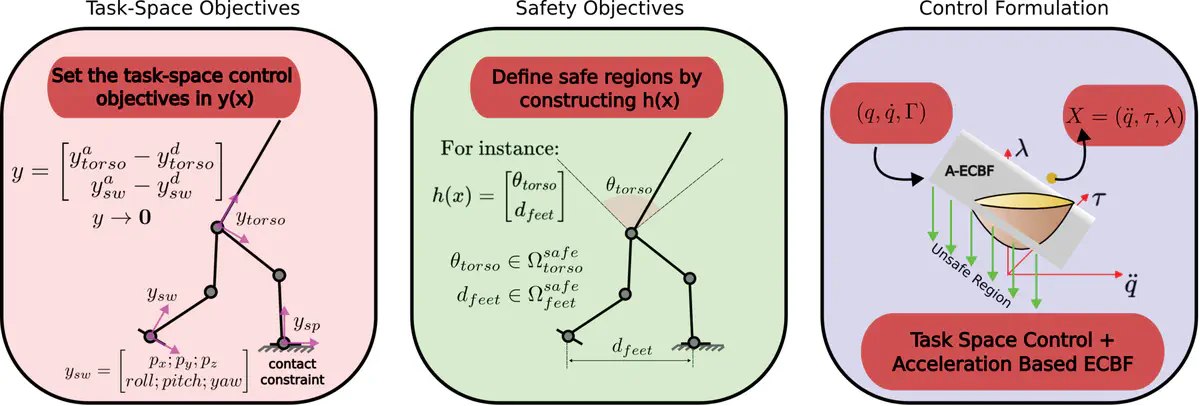
A humanoid must balance while coordinating many competing motion tasks. We formulate controllers that account for dynamics, contacts, actuator limits, and model-based safety constraints.
- Define balance and motion tasks
- Enforce dynamics and contact constraints
- Compute whole-body control inputs
The problem
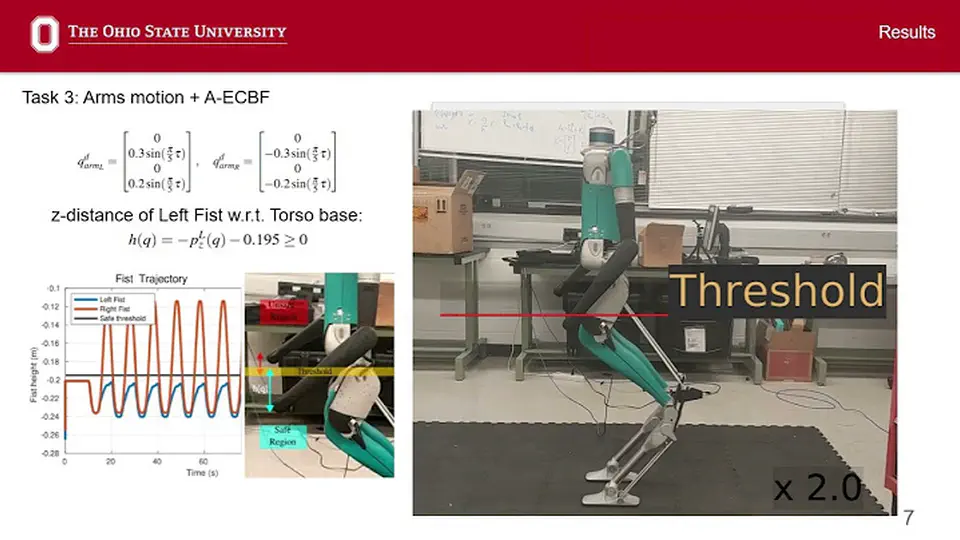
A humanoid controller must coordinate balance and motion while respecting actuator limits, unilateral contacts, friction, and closed kinematic chains. Competing tasks can drive the robot toward undesirable configurations.
Our approach
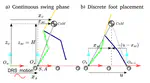
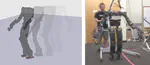
We formulate inverse-dynamics quadratic programs with task-space objectives and control barrier functions. Related foot-placement work accounts for periodically swaying ground using a time-varying reduced-order model.
Results and experimental setting
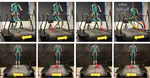
Safe whole-body task-space control was evaluated on Digit in simulation and hardware experiments. Swaying-ground foot-placement control was also tested in both settings. The mathematical results apply under the models and sufficient conditions stated in each paper; the experiments cover the reported tasks and disturbances.
Papers and demonstrations
Watch the whole-body control experiments and the swaying-ground experiments.
Explore the controller illustration